Container Vegetable Trellises: Choose, Set Up & Train
Container vegetable trellises work best when you match the support to the crop’s mature size, install it before planting and keep the whole planter stable. Peas and climbing beans need something to grip or twine around; tomatoes need tying or a cage. A trellis saves spreading space, but it does not reduce the roots’ need for a suitable container, water or nutrients.
Start with one supported crop in a sheltered position. A manageable structure that you can water, inspect and harvest from is more useful than a tall display that blocks a door or sways whenever the wind rises.
Choose the crop before the trellis
Read the variety label for growth habit and mature height. “Bush,” “dwarf” and “patio” usually describe more compact growth, but they do not promise that every plant can stand unsupported. A compact tomato carrying fruit may still need a cage. A genuinely dwarf French bean usually needs no climbing structure.
Climbing peas use tendrils to hold slender supports. Pole beans wind their stems around upright poles or cords. Cucumbers have tendrils, while tomato stems need deliberate support and fastening. This difference determines whether a simple cane, mesh panel or cage will work. For sowing, pot size and fruit set, see our guide to growing cucumbers in containers.
The University of Minnesota Extension trellis guide distinguishes climbing crops from tomatoes and recommends matching the framework to the vine and fruit. Large pumpkins and heavy squash are poor starter choices for a small container trellis. Choose a crop you can keep within reach instead.
| Crop or habit | Useful support | What to check |
|---|---|---|
| Climbing peas | Firmly secured fine branches or taut mesh | Thin gripping points and the packet’s height |
| Pole or climbing French beans | Strong upright canes, cords or a wigwam | Root volume, height and resistance to tipping |
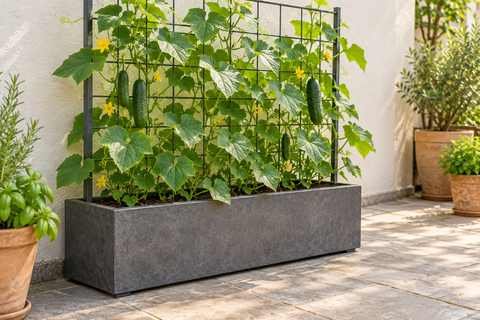
| Vining cucumber | Rigid grid on a sound frame | Fruit access and vine weight |
| Tomato | Suitable cage or sturdy stake with soft ties | Determinate versus indeterminate size |
| Dwarf bush bean | Usually none; short twigs if needed | A tall trellis will not turn it into a climber |
For a complete cool-season crop plan, use our container snap pea guide. The trellis is only one part of that crop’s setup.
Plan the footprint, light and season
Measure the planter’s width, the support’s full height and the space you need to reach behind it. Leave room to lift a watering can and check the back of leaves. Avoid putting climbing foliage directly across an opening window, exit or shared path.
Watch the actual sun pattern. A wall can provide shelter while also creating deep shade or reflecting afternoon heat. Place a tall crop where its eventual canopy will not shade every smaller pot. Our balcony vegetable layout guide helps with that wider arrangement.
Timing follows the vegetable rather than the trellis. Peas generally suit cooler growing conditions; French beans and cucumbers need warmth and protection from frost. UK outdoor planting commonly waits until late spring or early summer for tender crops. US dates vary widely between northern, southern and coastal climates, so use your local extension calendar and forecast rather than copying a UK month.
Give the roots enough room
A narrow pot does not become suitable for a large vine just because a tall frame fits inside it. Check both usable depth and volume, allowing room for roots, support legs and watering space below the rim. For tomatoes, our tomato container size guide separates plant habits and capacity choices.
Climbing beans can require surprisingly large containers. The RHS runner bean guide specifies a broad, deep, heavy container for climbing varieties. Do not translate an in-ground row recommendation into a small decorative pot. If the required setup exceeds your space, choose a dwarf crop instead.
Use a free-draining container growing mix, called potting mix in the US and container compost in the UK. Follow its feeding instructions and keep drainage outlets clear. Our container potting mix guide explains those labels. Avoid adding a gravel layer as a drainage fix.
Install the support before sowing or transplanting
Put the empty planter in its final position first. Check that the surface is level and the container cannot rock. Fit a purpose-made support according to its instructions, checking joints, edges and all fixing points before filling and planting. Early installation avoids driving legs through an established root ball later.
A freestanding wigwam spreads its legs within a roomy planter and joins them securely at the top. A rigid panel needs a frame that holds it upright; a loose piece of mesh pushed into compost is not equivalent. A tomato cage must suit the mature plant, rather than merely fitting over a seedling.
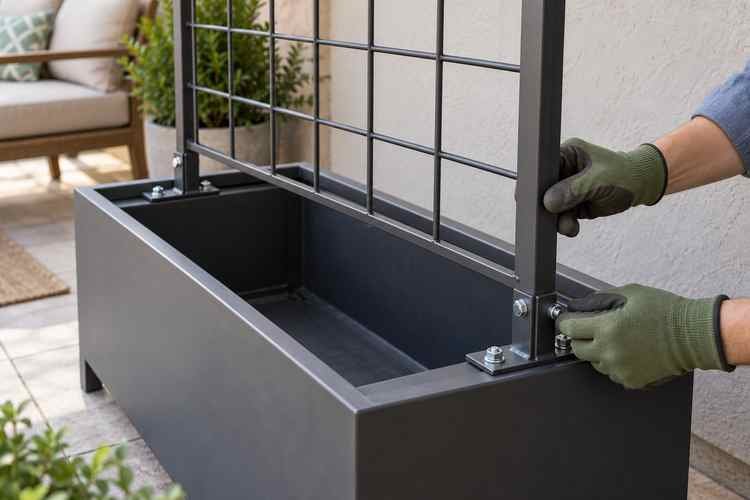
The University of Maryland container guide highlights the tipping risk of tall plants in lightweight containers. Wet foliage and developing fruit change the load. A sheltered ground-level patio is often easier to manage than an exposed terrace.
On a balcony or roof, confirm permitted loads and fixings before installing a large planter or tall support. Do not use a railing as an assumed anchor or suspend a heavy crop outside the edge. Where you cannot provide a stable installation, reduce the crop’s height and size; extra improvised weight is not a substitute for an appropriate design.
Guide growth with loose, regular adjustments
Sow or transplant at the spacing recommended for the variety. Trellising changes where the shoots grow, not the space each plant needs at its roots. Position seedlings close enough to reach the support without bending their stems sharply.
As growth extends, gently guide young shoots toward suitable gripping points. Do not force stiff stems through small openings. For a tomato, attach a soft, broad tie loosely to the support, leaving room for stem expansion. Avoid wire or thin cord pressed directly against living stems.
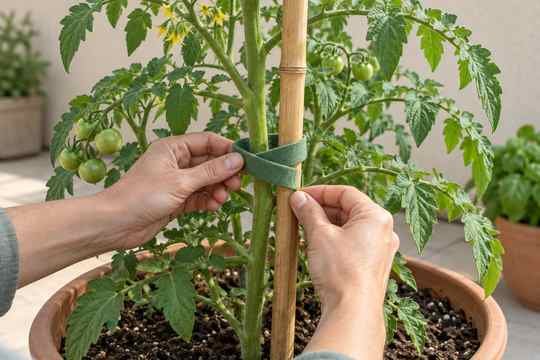
Check ties and shoots every few days during active growth. Loosen any fastening that starts to mark a stem. Keep fruit from becoming trapped inside a grid and maintain an opening for picking. Train while growth is flexible rather than trying to untangle a mature mass all at once.
Water, feed and inspect the supported crop
Check the root zone, especially in warm or windy weather. Raised foliage can look healthy while a small pot dries rapidly. Water the growing mix slowly and thoroughly when needed, allowing excess to escape. Use our container watering guide for moisture checks rather than relying on a rigid daily quantity.
Feed for the crop and the mix’s existing nutrient supply. Follow the product label; a trellis does not create a universal feeding schedule. Inspect leaf undersides, growing tips and joints for pests while you check ties. Remove fallen debris and keep room for air to move through the foliage.
Troubleshoot before the structure becomes crowded
| Problem | Likely checks | Practical response |
|---|---|---|
| Planter rocks or support leans | Loose joints, uneven base, wind exposure | Stop training upward; correct the installation before adding load |
| Vines miss the support | Wrong gripping surface or a large gap | Guide flexible shoots gently toward closer contact points |
| Stem pinched at a tie | Fastening has not expanded with growth | Replace it with a loose soft tie |
| Small plants below become leggy | Shade from the mature canopy | Rearrange shorter pots where accessible light remains |
Frequently asked questions
Can every vegetable climb a trellis?
No. Choose a climbing or trainable crop. Root vegetables and leafy rosettes will not climb, and a dwarf bush bean keeps its compact habit. Tomatoes can be supported vertically but do not attach themselves like peas.
Is a cane wigwam suitable for any pot?
No. The planter must have enough width, depth and stability for the crop and structure. A small pot with a tall canopy can topple. Use the variety’s container guidance and the support manufacturer’s instructions together.
Can I add a trellis after planting?
It is better to install it first. Retrofitting can damage roots or stems. If a planted crop needs help, choose an arrangement that avoids forcing long legs through its root ball, and check stability before training it.
Does growing vertically guarantee a bigger harvest?
No. It can make better use of spreading space and improve access, but results still depend on light, season, root room, water and plant health. Plan for a manageable crop rather than a promised yield.
Start with a support you can manage
Choose the variety, size the container, fit the structure early and keep the crop within reach. Regular checks of moisture, ties and stability matter more than building the tallest trellis in the smallest footprint.